Asian Money Matters: Artificial Intelligence
What I’m Learning—and Why It Matters

From inherited money habits to AI-powered financial confidence, Asian women are redefining financial independence, one question at a time.
It’s both artificial and intelligent, and whether we like it or not, AI has embedded itself into our daily routines and reshaping how, when, and where we interact with money.
Growing Up With an Unspoken Money Rulebook
Like many Asian women, I grew up with an unspoken rulebook: work hard, save quietly, and don’t take unnecessary financial risks. Financial literacy wasn’t actively taught; it was assumed that money sorts itself out “just happens” once wages are deposited in the bank.
For many of us, that’s where engagement with money began and ended. Saving was passive, investing was daunting, and exploring financial options felt like stepping into unfamiliar territory - a domain historically dominated by men.
Today, thanks to AI, the digital landscape has shifted, and continues to shift. We are moving away from a world where we simply "ask" for information and into an era where AI can "act" on our behalf, allowing us space to think more strategically. This transition from basic assistance to active agency is quietly dismantling the old barriers, replacing gatekeepers with algorithms that make sophisticated wealth management more accessible and personalized. The question is no longer whether the financial world will change, but how quickly we as Asian women choose to embrace and lead this change.
What “Using AI” Actually Means
It is fascinating to see the landscape shifting from today’s assistive AI—which simply answers questions—to a near future of agentic AI that executes complex, high-stakes workflows. While we are currently in a "guidance" phase, the bridge to full autonomy is being built rapidly. Historically, tools like Siri and Alexa were launched as reactive, domestic helpers, often tethered to female names and voices that subtly reinforced traditional roles of assistance and coordination.
However, as we move into a faceless arena, women are capitalizing on this technology for far more than "digital housekeeping." The next generation of agentic AI is shifting from planning dinner parties to executing sophisticated professional and financial strategies. These autonomous agents are becoming powerful proxies—capable of independently optimizing diverse investment portfolios and navigating wealth management with a single command.
For many women, this evolution is prying open doors that were once backlogged by bureaucracy or guarded by traditional gatekeepers. By moving past the "assistant" stereotype, the evolving agentic AI is being used to bypass the friction of outdated financial systems and manual negotiations. The future of AI for women isn't about having a voice that helps us stay organized; it’s about having an agent that helps us command our wealth and professional trajectory with precision, turning a historically closed landscape into an accessible, one-click reality.
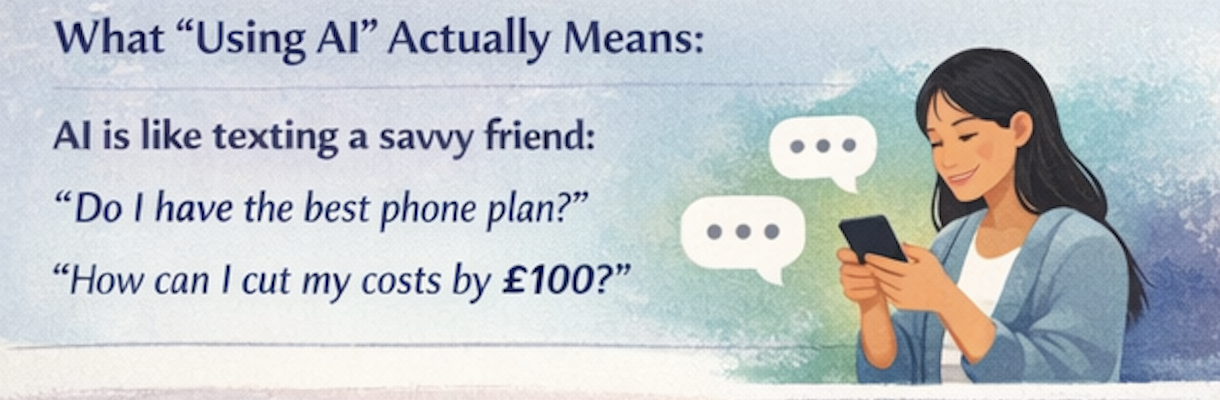
AI at its core is evolving from a search engine into an on-demand strategist. In practice, using AI is like texting a knowledgeable mentor who is always available to sense-check your trajectory.
💬 Strategic Guidance: Moving from "What is a stock?" to "How do I optimize this portfolio?"
📊 Financial Clarity: Instant visualization of wealth, moving past the intimidation of spreadsheets.
🔄 Agentic Automation: Turning financial plans into executed actions without the bureaucracy.
👩👧 Generational Impact: Changing the "rulebook" we pass down to the next generation.
By using these tools to handle the heavy lifting of research and execution, the mental load of "money matters" starts to lift. Over time, these interactions make the financial landscape feel less like an unfamiliar territory and more like a domain we are meant to command.
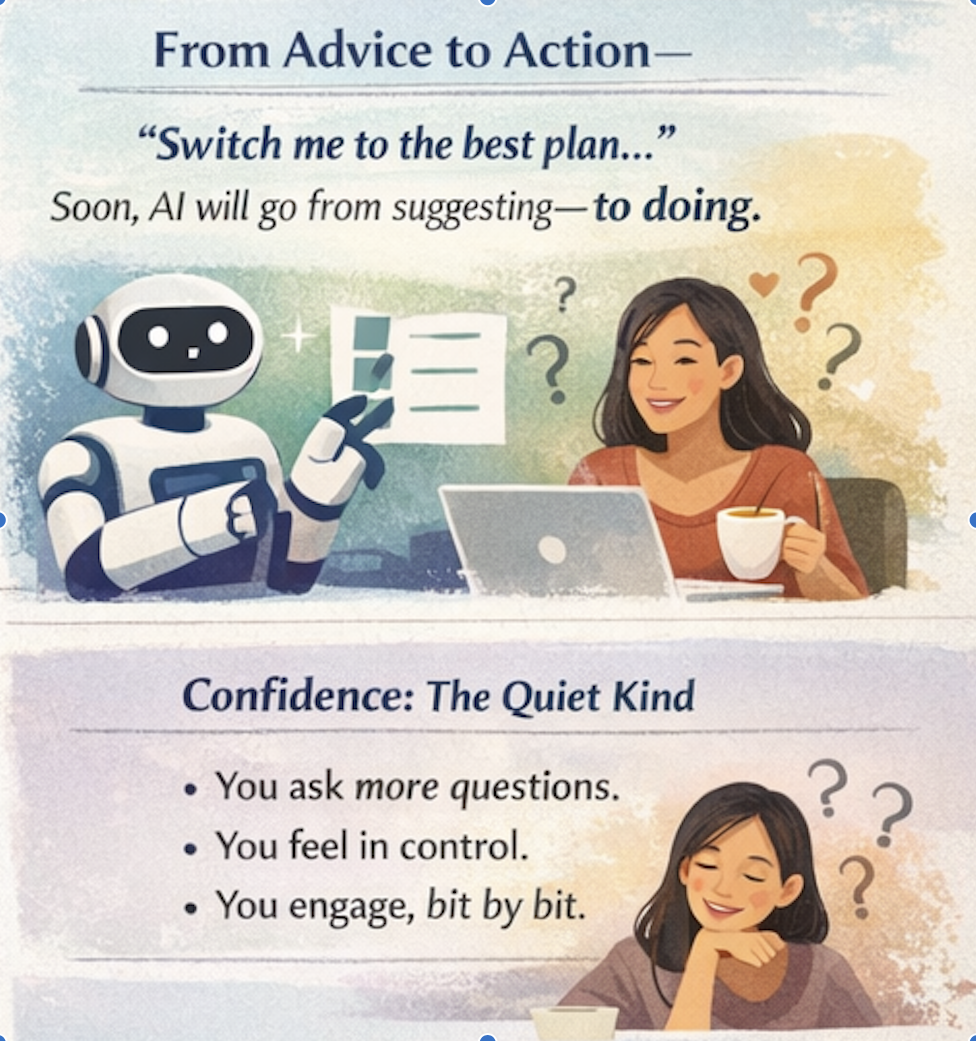
Instead of spending hours with google research, you can simply ask AI in plain language:
“Do I have the best home and car insurance plan?”
“Am i still on track to retire at 55?”
…and receive tailored, immediate guidance, based on your inputs.
Each AI question and answer can be organized by threads to allow for tailored conversations.
A Note of Caution
One thing AI has in common with humans is that it also makes mistakes. It can forget prompts, misinterpret questions, and mix data from past prompts with current prompts, make assumptions, or fail to explore all possibilities. It is therefore important to be cautious - AI’s growth rate is faster than the regulations that are needed to safe guard users.
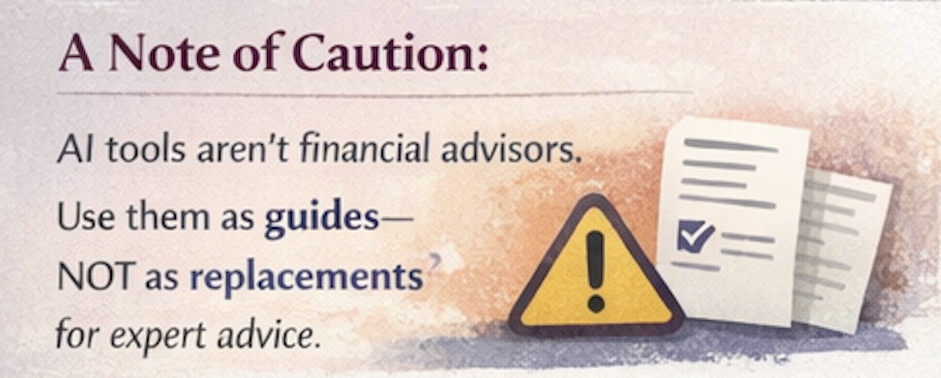
AI can provide incorrect tax or ISA guidance
Can invade your data privacy
Cause security threats
And discriminate
AI drawbacks were referenced in an article published on BBC.com, which stated that AI informed some users to use “non-toxic glue” when asked how to make cheese stick to pizza, and another AI search response claimed that geologists recommend humans eat one rock per day. This is alarming if one cannot decipher fact from fiction.
AI Tools
AI tools help reduce friction, save time, and support decision-making, but should be used as a starting point—not as a final authority.
ChatGPT: great for everyday financial decisions
Gemini: useful for day-to-day administrative tasks
Claude: useful for reasoning
Perplexity: helpful for checking UK-specific regulations
Final Thoughts
As Asian women, we find ourselves at a pivotal point where we are balancing two forces:
Values we were raised with: Discipline, responsibility, caution
A world that rewards: Curiosity, adaptability, and decisive action.
AI isn’t something we need to master overnight; it is a tool we can build upon as we navigate our financial lives. We can leverage these agents to redefine our financial independence, not just for ourselves, but also for the next generation. By using AI as a partner to navigate uncertainty, and empower, and accelerate our decisions, we’re no longer "saving quietly"— we are building a financial future, on our own terms, with a goal not just to keep up with AI, but to harness this revolution to set our own pace.
“AI is the best thing to happen to women's finances in decades, offering a tool to bridge the confidence, wage, and wealth gaps faster than ever before." — Parthean.
Thank you for reading this article. Images in this article are generated by AI. Your feedback on the Asian Money Matters is welcomed at support@ambercommunity.net